I might be a bit late in finishing and posting this, but as of writing this now the date is January 27th. Today is Holocaust Memorial Day, a day for remembering the millions of victims of the Holocaust. I am not Jewish, nor do I have any Jewish relations or any other personal relationship with the Holocaust, but as a member of the human race I think it is incredibly important to remember and understand one of the most large-scale and depraved acts of evil in human history.
Unfortunately, we as a species don't seem to have learned the important lessons from the Holocaust. We have committed many genocides since, some continuing to this day. The rhetoric the Nazis used to enact and justify the Holocaust is still widely used in far-right politics in the U.S. and Europe. It is still effective in spreading bigotry and enabling genocide. I think the general public's understanding of the Holocaust is limited in many ways. Most people understand, to varying degrees, the great horrors that took place on the trains and in the concentration camp walls. What people don't seem to understand is how it happened and the lasting impact it has on human civilisation.
The evil of the concentration camps is taught, but far rarely do people learn the mechanisms of propaganda and dehumanisation used by the Nazis, still used today to justify killing Palestinians and others. Less focus is placed on the slow process before the Holocaust of Jewish people losing their possessions and their humanity. Less focus is placed on the human beings that caused and suffered the Holocaust that allow us to learn lessons that can apply to all of us, regardless of the difference in situation.
This inadequate teaching of the Holocaust as a unique evil divorced from the rest of human history is often a result of poor resources being used to teach the Holocaust. One of the most common resources used to teach about the Holocaust is The Boy in the Striped Pyjamas, a film that the Auschwitz Museum says “should be avoided by anyone who studies or teaches about the history of the Holocaust” because of the myths it perpetuates. A lot of the teaching of the Holocaust doesn't centre on actual survivors stories, and can miss some of the smaller but still incredibly important details. Some of these experiences have been banned in U.S. states. I can't tackle all the issues around the portrayal of the Holocaust, but I wanted to share three pieces of Holocaust media that had a huge impact on me and helped me understand it better.
This is the number one resource I would recommend to anyone who wanted to learn about the Holocaust. Even as a graphic novel, it might be my favourite work of literature ever. The novel is split into two volumes and covers the experiences of author Art Spiegelman's father Vladek as a Polish Jew and survivor of the Holocaust.
I think this is such an incredible resource for two reasons. The first is the totality: Not only does it describe Vladek's experience in the camps, it tells his story from being free and starting a family in 1936 Poland all the way to leaving the camp and moving to America. It's also written as a meta-narrative, including sections of Art, Vladek and their family in the present day (throughout the 1980s). It shows Vladek's family life far after the Holocaust, as well as Art's experiences interviewing his father, working on the novel and struggling with self-doubts. As well as showing the brutality of the camps, it shows the slower path of dehumanisation that Jews experienced in Poland in the years before the concentration camp. Many of them predicted what would happen to them, but were powerless to stop it. Many citizens knew about it but allowed it to continue or willed it on. It destroys the subconscious idea some have that the Holocaust happened out of thin air. It also shows the long-term impact on one of its survivors, and the generational trauma passed on to his son. As Art says about his father “In some ways, he didn't survive.”
The second reason I think Maus is a great resource is its authenticity. It is a deeply human story. It describes the exact experiences of a real human being inside the camps, what he gained and lost, how he managed to survive. It brings a personal element, a peek inside the mind of one of the many human beings put through those conditions. This element is often obfuscated by the scale of the Holocaust. This can function as a kind of desensitisation: It's impossible to imagine the totality of the suffering of each concentration camp victim. To better understand the suffering the Holocaust caused, we must zoom in to the story of one man. We can relate some of Vladek's experiences to our own, the way he finds love and friendship, the work he does, the specific ways he suffers, from minor to major.
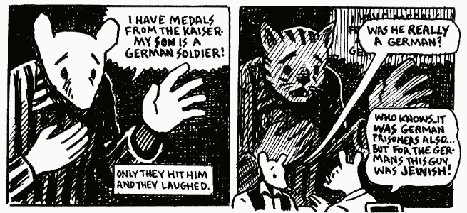
Maus also refuses to sanitise its story. It demystifies some of the ideas about the Holocaust, and challenges the harmful myths and assumptions about it. It challenges the simplistic noble view of the survivor. As Art said while discussing the novel, “Look, suffering doesn't make you better, it just makes you suffer!” This idea is supported throughout Maus: Vladek is a miser, has a very short temper and is often very frustrating to the people around him. Art sees a therapist about his struggles with his father. In one scene, Vladek is racist towards a black hitch-hiker, and when called out on his racism and hypocrisy as a Holocaust survivor, says that Jewish people aren't like black people. In Maus, he is treated with the complexity and nuance that is required to understand any human being. The trauma of the Holocaust never left him, but it also never made him a better person. I feel that this idea is incredibly important when thinking about the genocide being committed in Gaza by Israel, as many people can't seem to understand that a race which survived the Holocaust would go on to commit a genocide against another group.
I have heard many times people say that a book or a film or a band 'changed their life'. I always found it a little exaggerated to me. Pieces of art had had profound effects on me before, and ‘changed my life' in the literal sense, but I'd never felt my entire worldview shift in a way that justified the phrase. That's until I read Man's Search For Meaning, which I have no reservations saying changed my life. The book is split into two connected parts: an account of author Viktor Frankl's experience in a concentration camp (which I will focus on here), and an explanation of Logotherapy, a form of therapy he developed from his experiences, based on existentialist philosophy.
Much of Frankl's focus is on the psychological aspect of surviving a concentration camp. It explores the desensitisation he experienced: At one point he sees a dead body and feels so little that he only remembers the event because of his scientific curiosity about his reaction. It also explores the incredible human ability to acclimate to almost any conditions, including the ones experienced in the camps. He recalls seeing a picture of people sleeping in the camp beds, someone telling him how awful it was and him wondering why, as sleeping was the best part of a camp life he had gotten completely used to. He rejects the idea that the experience of being a prisoner in a concentration camp is so foreign that it can't be applied to our lives. He relates his incredible suffering to our comparatively mundane problems, saying “A man's suffering is similar to the behavior of gas. If a certain quantity of gas is pumped into an empty chamber, it will fill the chamber completely and evenly, no matter how big the chamber. Thus suffering completely fills the human soul and conscious mind, no matter whether the suffering is great or little.” The book focuses on the ways we can use the lessons he learned from the Holocaust to find meaning in our own lives: by striving towards a goal, appreciation of art and the world, and in the triumph over unavoidable suffering.
The book also places an importance on the fact that everyone in the camps is a unique human being. The prisoners are capable of being helpful to each other, or of committing acts of intense cruelty. Many of the guards were the sadists we typically associate with Nazi soldiers, but many had little interest in punishing the prisoners and would sometimes take pity on them and offer them food. I think this is an incredibly important lesson to learn about the Holocaust: that it was perpetrated by human beings against other human beings. It can be easy to view the Holocaust in a good/evil binary that allows us to ignore the capacity for good or evil present in us all. Nazis are not a unique species capable of unique evil, they are human beings like you and I. Their evil was not mystic or unreachable, it was human.
Given this difference, there was also a huge difference in the mindsets of the prisoners. Many gave up on life, committing suicide or allowing themselves to die. Others fought as hard as they could, for their families on the outside or for any other reason they could will themselves to keep living. There was also a huge difference in the former prisoners who survived the camps. Some slowly learned to find joy again as a free person, but others used the suffering that they had endured to justify inflicting suffering onto others. As in Maus, their suffering didn't make them better people. As Art's therapist, also a Holocaust survivor, says to him, “It wasn't the best people who survived, nor did the best ones die. It was random!”
I've added this film on to the end, less because I think it's useful for learning about the Holocaust but because I absolutely love it. If you want to avoid minor spoilers for it, stop reading here.
Life Is Beautiful tells the story of a man courting a woman he'll eventually start a family with, and the family being taken to concentration camps, the man and his son in one and his wife in the neighbouring camp. While it does feature the Holocaust, and is partially inspired by the life of a Holocaust survivor, it's not really about the Holocaust in the same way. It uses the Holocaust as a vessel to tell a story about the human spirit. The main character Guido is like a slapstick comedy character: he's incredibly outlandish, childish and happy-go-lucky. Throughout his experience in a concentration camp, Guido maintains the same spirit for the sake of his son, pretending that the entire concentration camp experience is a game. People have criticised the film for the lighthearted and comedic tone it takes despite partially taking place in a concentration camp, but to me it shows the power of the human mind and spirit to frame the suffering that it goes through. It echoes the ideas in Man's Search For Meaning, as Guido manages to overcome massive amounts of unavoidable suffering for the sake of his wife and child. He represents a kind of ideal human being, one that might not be attainable but is nonetheless incredibly inspiring.
I think it's incredibly unlikely that humanity learns from the Holocaust and stops repeating its mistakes. Despite this, I think everyone has the opportunity to learn a lot about society and human beings through understanding such a horrible event that was allowed to happen. The Holocaust is such a poignant reminder of the ways human beings hurt each other, in overtly violent or more subtle and psychological ways, on a personal level or on the scale of millions. It's a lesson in the mechanisms of bigotry, dehumanisation and the power of propaganda. It can also be a lesson in the power of human strength and the ability to overcome suffering, which can be utilised by anyone, even those suffering far less than concentration camp victims. It's now January 28th as I'm finishing this, but it is still important on this day and every other day to remember the Holocaust. Thanks for reading.